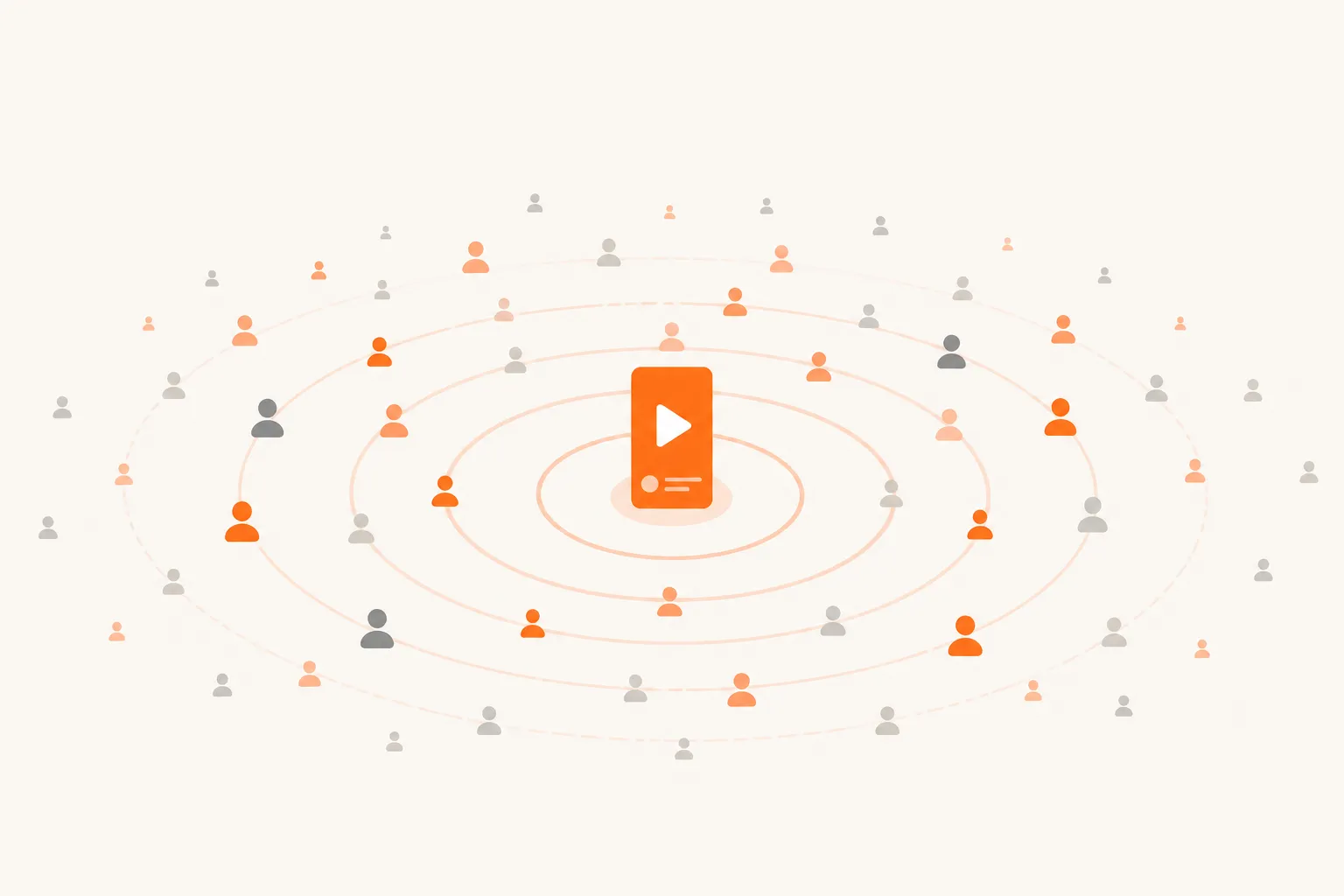
The TikTok algorithm works by testing every new video on a small pool of people in your niche, then expanding its reach in waves based on how they respond, mainly completion rate, rewatches, shares, and how fast those signals arrive. Your follower count barely matters. Each post is judged on its own first few hundred views.
Here's exactly how a video travels from upload to For You page.
How does the TikTok algorithm work?
TikTok is a recommendation engine, not a follower feed. Its only goal is to keep people scrolling, so it constantly asks one question: will the next person watch this to the end?
To answer it, TikTok runs every upload through the same pipeline:
- Moderation. The video is scanned for policy and copyright issues first.
- Cold test pool. It's shown to a small batch of users who already watch your niche.
- Signal reading. TikTok measures how that batch responds.
- Expansion. Strong signals push the video to a bigger pool. Weak ones stop it.
Every video starts from zero
Your last video's performance does not carry over. A post from an account with 200 followers can beat one from an account with a million, because each video is scored on its own merits.
- Followers don't guarantee reach; they only seed a slightly warmer starting pool.
- A viral hit doesn't "lift" your next post automatically.
- A dead account can still post a video that explodes overnight.
This is why chasing followers is the wrong game. Chase completion rate instead.
What is the TikTok test pool?
The test pool is the small group of users TikTok shows your video to first. It isn't random. TikTok picks people most likely to sit through your content: viewers who already watch your exact niche.
That's deliberate. If the algorithm showed cooking videos to gym accounts, completion rates would crater and good content would look bad. By matching your video to the right audience first, TikTok gives it a fair test.
The takeaway: post consistently in one clear niche so TikTok knows who to test you on.
The 4 signals TikTok ranks on
Once your video hits the test pool, TikTok reads four signals, in this order of weight.
- Completion rate: did they watch to the end? This matters most.
- Rewatches: did they loop it or watch twice?
- Shares: did they send it to someone off the app or in DMs?
- Velocity: how fast all of that happened after posting.
Likes and follows barely move the needle. TikTok cares about attention and distribution, not vanity metrics.
Which signal matters most?
| Signal | Why it matters | How to win it |
|---|---|---|
| Completion rate | Proves your video holds attention | Strong hook, short runtime, no dead air |
| Rewatches | Doubles watch time per viewer | Loopable ending, detail people replay |
| Shares | Free distribution off your reach | Make it relatable, useful, or reaction-worthy |
| Velocity | Signals a hit early | Post at active times; front-load engagement |
Completion rate is the foundation. A 7-second video watched in full beats a 60-second video most people swipe past at second three.
How reach expands in waves
If your video clears the first pool, TikTok pushes it to a larger one, then a larger one again. Each wave is a fresh test.
- Wave 1: a few hundred niche viewers.
- Wave 2: a few thousand, if completion and shares held up.
- Wave 3+: tens of thousands and beyond, spreading past your niche.
A video "goes viral" when it keeps passing each wave. It stalls the moment a wave's completion rate drops, which is why so many posts freeze at a few hundred views.
How to work with the algorithm
You can't hack the algorithm, but you can feed it what it rewards.
- Nail the first 3 seconds. The hook decides completion rate. Open with motion, a bold claim, or a question.
- Keep videos short. Shorter runtimes are easier to finish, which lifts completion rate.
- Make it loop. An ending that flows back into the start earns rewatches.
- Give a reason to share. Relatable, useful, or reaction-worthy content spreads on its own.
- Post in one niche. Consistency sharpens the test pool so the right people see you.
- Post at volume. Every video is a fresh lottery ticket: more shots, more chances to clear the waves.
Volume is the part most creators skip. Testing many videos in your niche is exactly what ViralGrow automates: it generates faceless slideshows and AI reaction videos and posts them to TikTok, Reels, and Shorts on a schedule. For the content side, see our guides on how to go viral on TikTok without filming and the TikTok slideshow strategy, or check pricing if you want the posting handled for you.
The bottom line
The TikTok algorithm doesn't judge your account: it judges your first 500 views. Win completion rate, rewatches, shares, and velocity in that early test pool, and TikTok expands your reach wave after wave. Post consistently in one niche, at volume, and let the best videos climb.