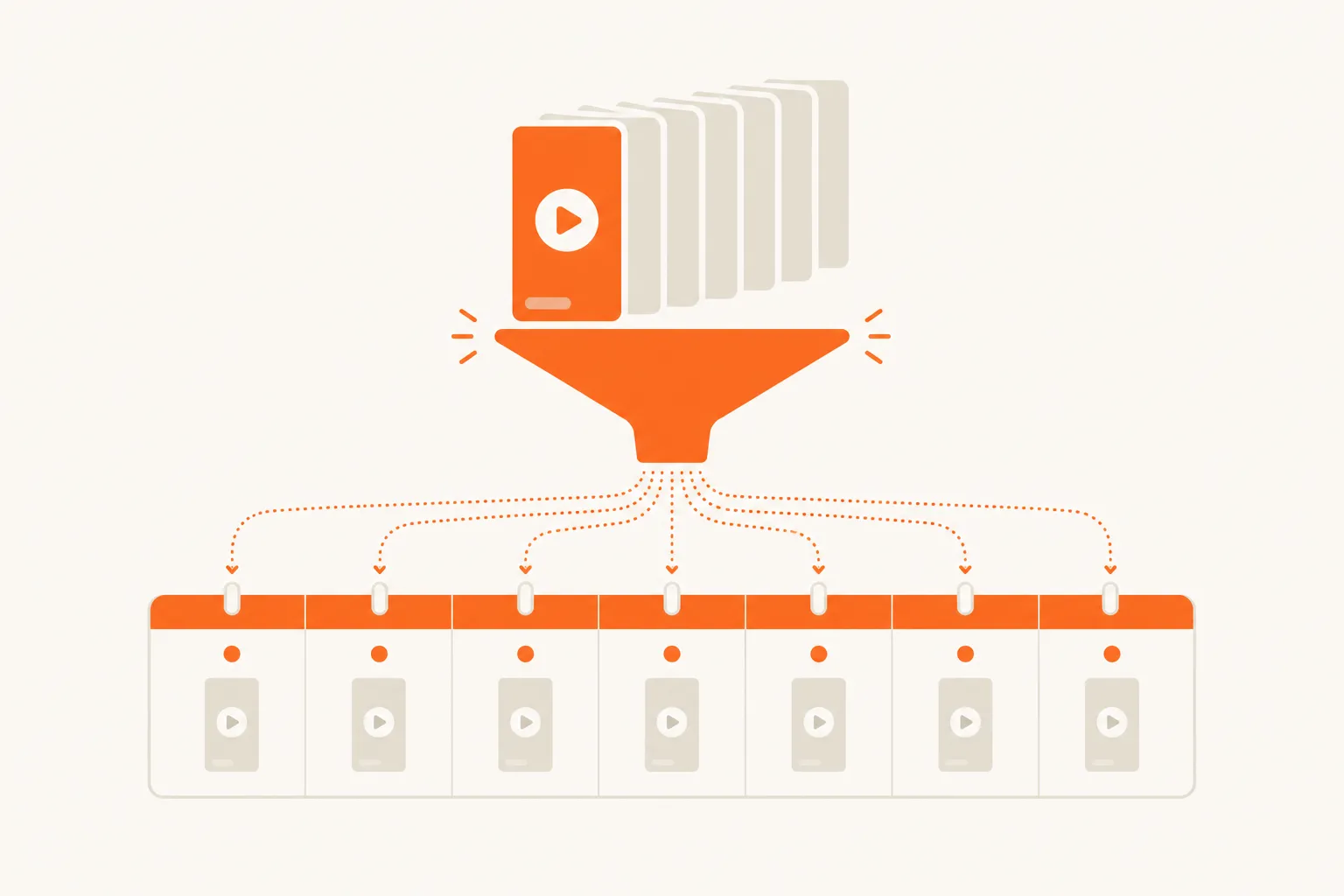
Content batching means making a full week of short-form videos in one focused session, then scheduling them to post daily. You produce in bulk once, so posting every day never depends on you having time that day. One work block covers seven feeds.
Here's how to batch a week of content in a single sitting, and why it beats making videos one at a time.
What is content batching?
Content batching is producing many videos in one session instead of one per day. You group the same task (scripting, recording, editing) and knock it out in bulk.
Instead of "make a video today, then another tomorrow," you make seven today and schedule them across the week.
- One setup, one mindset, one block of focus.
- Output is a queue of finished clips, not a single post.
- Daily posting becomes a scheduling task, not a production task.
Why does content batching work?
Because the time you lose is between tasks, not inside them. Setting up to film, switching to editing, then writing captions: every switch has a cost, and doing it daily pays that cost seven times.
Batching pays it once.
- You stay in one mode, so you get faster with every rep in the session.
- Momentum builds: the fifth script is quicker than the first.
- A bad or busy day can't break your streak, because the week is already made.
This is the engine behind posting daily. See how often to post on TikTok for why that cadence matters so much.
How to batch a week of short-form video in one sitting
Batch by task, not by video. Do every script first, then every recording, then every edit, never one full video start to finish. Follow this order.
- Pull 7 ideas from your list. Start with a running idea bank so you never open the session cold.
- Script all 7 at once. Write every hook and caption back-to-back while you're in writing mode.
- Set up once. Frame your shot, lighting, or template a single time for the whole batch.
- Record all 7 in a row. Keep the camera rolling through every clip before you touch anything else.
- Edit in bulk. Apply the same cuts, captions, and format to all seven together.
- Export clean masters. Save watermark-free 9:16 files so each can cross-post later.
- Schedule the week. Queue one clip per day so posting runs without you.
Set this up once and a week of content takes a few hours, not seven separate sessions.
What do you need before a batch session?
Walking in prepared is what makes batching fast. Gather these before you start, not during.
- An idea list. 10+ topics ready so you never stall mid-session hunting for the next one.
- One repeatable format. A template you fill in, so you're producing (not reinventing) each clip.
- A hook bank. Proven opening lines you can adapt fast. See best TikTok hooks for faceless videos.
- A single niche. Staying on one topic keeps scripting fast and tells the algorithm who to test you on.
- A scheduling tool. Somewhere to queue the finished clips so daily posting is automatic.
The prep is the whole game. A stocked idea list turns a batch session into assembly, not invention.
How many videos should you batch at once?
Match your batch size to how fast you can produce without the hook slipping. Use this as a starting map.
| Your stage | Batch size | Session length | Covers |
|---|---|---|---|
| Just starting | 5–7 clips | 1–2 hours | One week, posting daily |
| Consistent | 10–14 clips | 2–3 hours | 1–2 weeks at 1–2/day |
| High volume | 20–30 clips | Half a day | 2+ weeks at 2–3/day |
| Faceless / automated | 30+ clips | Minutes | Weeks, generated in bulk |
Faceless and automated accounts sit at the top because a repeatable template lets them mass-produce without filming. That's the point of the format.
What are the biggest content batching mistakes?
Batching fails when it turns back into one-video-at-a-time work in disguise. Avoid these.
- Editing each video before recording the next. That's context switching: the exact cost batching removes.
- Starting with no idea list. Inventing topics mid-session is where the hours vanish.
- Batching a format that's slow to make. If one clip takes an hour, seven is a full day. Pick something repeatable.
- Skipping the schedule step. A queue of finished clips that never gets posted defeats the whole system.
- Perfecting instead of producing. The goal is seven watchable clips, not one flawless one.
Fix these and a batch session actually delivers a stocked queue instead of one polished video.
How to batch faceless content on autopilot
Doing this by hand works, but the ceiling is your time. To batch real volume, automate the production and posting themselves.
- Standardize one format. A faceless slideshow or reaction template is fastest to mass-produce.
- Generate in bulk. Let a tool create a week or month of clips from your ideas at once.
- Auto-caption per platform. Have hooks and captions written for each upload automatically.
- Schedule across platforms. Queue clips to TikTok, Reels, and Shorts so they ship on their own.
This is exactly what ViralGrow is built for: it generates faceless vertical videos in bulk, writes the captions, and auto-posts them to TikTok, Reels, and Shorts on a daily schedule, so your whole week is batched and queued without a camera. Pair it with how to repurpose short-form video to stretch each clip across three feeds, or read how to automate short-form content for the full pipeline. See pricing to have batching handled for you.
The bottom line
Content batching means making a full week of short-form video in one focused session, then scheduling it out. It works because it kills the context switching that slows daily production. Batch by task, prep an idea list first, and let one work block feed a week of posts: that's how you stay consistent without burning out.