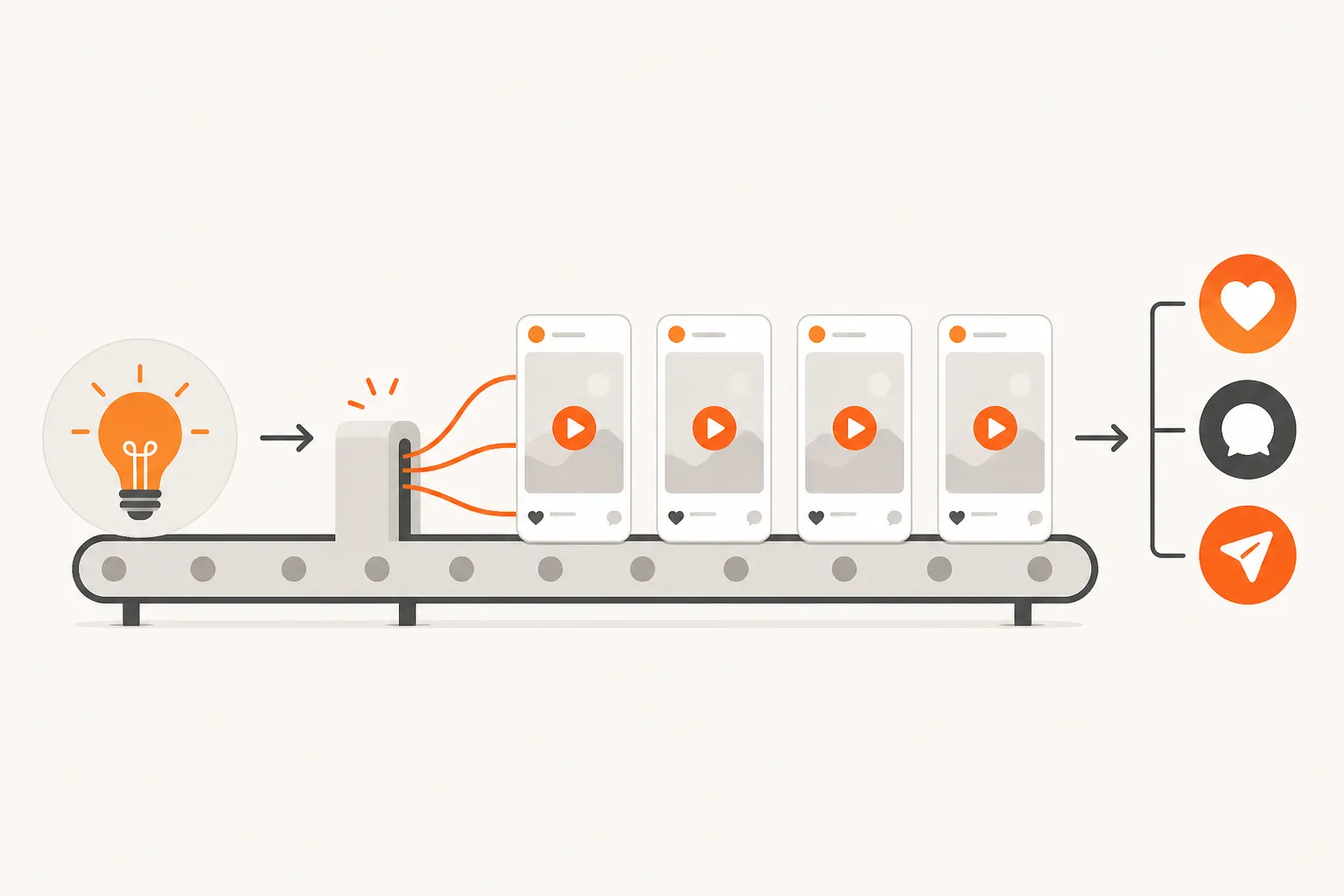
To automate short-form content end to end, connect five stages into one pipeline: idea, script, visuals, captions, and posting, then run it daily on a single repeatable format. AI handles the production, a scheduler handles the posting, and you only steer the ideas and hooks. Done right, faceless clips ship every day without you touching a camera.
Here's how the full automation pipeline works and how to build it.
What does it mean to automate short-form content?
Automating short-form means turning a one-off creative task into a repeatable system that runs with little manual work. Instead of making each video by hand, you assemble a pipeline that produces and posts them.
The goal isn't to remove humans entirely. It's to remove the slow, repetitive parts (editing, exporting, captioning, and uploading) so you can run at volume.
Can you really automate short-form content end to end?
Yes, every stage of the pipeline can be automated. Modern AI tools cover idea generation, scripting, visuals, voiceover, and captions, while scheduling tools handle the posting.
- Ideas: AI can pull trending angles and generate hooks in your niche.
- Production: AI generates slideshows, voiceovers, and even AI UGC-style talking videos.
- Posting: Official APIs let tools upload to TikTok, Reels, and Shorts on a schedule.
The only part worth keeping human is direction, your niche and your best hooks. Automate everything downstream of that.
How to automate short-form content: the full pipeline
Build it in five stages. Each stage feeds the next, so once it's set up, videos flow through without manual handoffs.
- Lock one niche and one format. Pick a faceless format you can repeat forever: slideshows or AI reaction videos.
- Automate idea and hook generation. Use AI to bank 20+ hooks at a time so you never start from a blank page.
- Automate production. Turn each hook into a finished video (visuals, captions, and sound) with AI instead of manual editing.
- Automate captions and metadata. Auto-generate the on-screen text, caption, and hashtags for each post.
- Automate posting. Connect a scheduler that auto-uploads to your accounts at set times, every day.
Set it once, then your job shrinks to reviewing hooks and doubling down on winners.
What parts of the workflow can you automate?
Almost all of it. Here's what to automate versus what to keep human, stage by stage.
| Stage | Automate it? | Who's better |
|---|---|---|
| Niche selection | No | Human |
| Hook / angle ideas | Partly | Human + AI |
| Script / captions | Yes | AI |
| Visuals & video | Yes | AI |
| Voiceover | Yes | AI |
| Scheduling & posting | Yes | Automation |
| Reading what won | No | Human |
The pattern is simple: humans set the direction, machines do the volume. You stay in charge of taste; automation handles the reps.
Best formats for automated short-form content
Some formats automate far better than others. The best ones need no filming and follow a repeatable template.
- Slideshows. Photo carousels are the easiest format to mass-produce: just images, text, and a hook. See the TikTok slideshow strategy guide.
- AI reaction videos. An AI presenter reacts to a clip or trend; viewers rarely notice it's synthetic.
- AI UGC. Synthetic creators deliver a script to camera. See what AI UGC is and how to use it.
- Text-on-screen list videos. Quick tips and lists over a trending sound.
All four share one trait: a template you fill and repeat, which is exactly what makes them automatable at scale.
Does automated content actually go viral?
Yes, because TikTok scores every video on its own test pool, not on how it was made. The algorithm cares about completion, rewatches, and shares, not whether a human filmed it.
- Every post starts from zero and is judged on the first 500 views.
- Automation gives you more videos in that test, and it only takes one to break out.
- A strong hook on an AI-made clip beats a weak hook on a hand-filmed one.
For the full mechanics, see how the TikTok algorithm actually ranks videos. The takeaway: volume in one niche is your biggest lever, and automation is how you hit that volume.
How to keep automated content from looking spammy
Automation fails when it turns into low-effort spam. Keep quality high with a few guardrails.
- Protect the first 3 seconds. Never let a rushed hook ship; that's what stops a post cold.
- Stay in one niche. Mixed topics confuse the algorithm and your audience.
- Vary the template. Rotate hooks and visuals so posts don't look identical.
- Space your posts. Keep uploads a few hours apart, not dumped all at once.
- Disclose synthetic media. Label AI creators when required; it keeps you compliant and trusted.
Automation should raise your output, not lower your bar. Review the hooks, cut the weak ones, and let the system post the rest.
The tools you need to automate short-form
You can stitch this together from separate tools (an AI writer, an image generator, a video editor, and a scheduler) or use one platform that runs the whole pipeline.
This is exactly what ViralGrow is built for: it generates faceless slideshows and AI reaction videos, writes the captions, and auto-posts them to TikTok, Reels, and Shorts on a daily schedule. You feed it a niche; it runs the volume the algorithm rewards without you touching a camera. To pace the output, see how often to post on TikTok, or check pricing to have the whole pipeline handled for you.
The bottom line
Automating short-form content means wiring idea, script, visuals, captions, and posting into one pipeline, then running it daily on a single repeatable format. Keep humans on the niche and the hooks; automate everything downstream. Do that, and you ship the daily volume that grows faceless accounts, without the manual grind.